
How to Improve Compacted Lawns Before Spring
A lawn can look green on top and still be failing underneath. If water puddles after irrigation, turf thins out in traffic lanes, or a screwdriver will barely enter the ground, the root zone is likely packed tight. Knowing how to improve compacted lawns helps property crews and homeowners fix the cause before summer heat turns a weak lawn into a renovation job.
Compaction is common across Utah sites. New construction, equipment traffic, clay-heavy native soil, repeated mowing patterns, and hard irrigation water can all leave soil dense and short on pore space. Roots need those small air spaces to take in oxygen, move into the soil, and reach moisture below the surface. When they cannot, more water and more fertilizer usually do not solve the problem. The lawn needs better soil structure first.
What Compacted Lawn Soil Does to Turf
Compacted soil holds particles too tightly together. Water may run off instead of soaking in, or it may pool on the surface because it cannot move through the profile. Air exchange slows down. Grass roots stay shallow, making turf less able to handle drought, heat, foot traffic, and winter stress.
The signs often show up in predictable places: along sidewalks, near playgrounds, around gates, in dog runs, beside driveways, and where crews turn mowing equipment. On commercial properties, compacted turf also appears in narrow strips between parking lots and curbs, on sports-field sidelines, and near building entrances.
Do not mistake every thin area for compaction. Shade, grub damage, poor irrigation coverage, salt, and low fertility can also weaken grass. A simple field check helps: push a long screwdriver, soil probe, or flag into the lawn after normal irrigation. If it stops within a couple of inches across several spots, the soil likely needs attention. Digging a small plug is even better. Look for roots clustered at the surface rather than extending down through loose soil.
How to Improve Compacted Lawns With Core Aeration
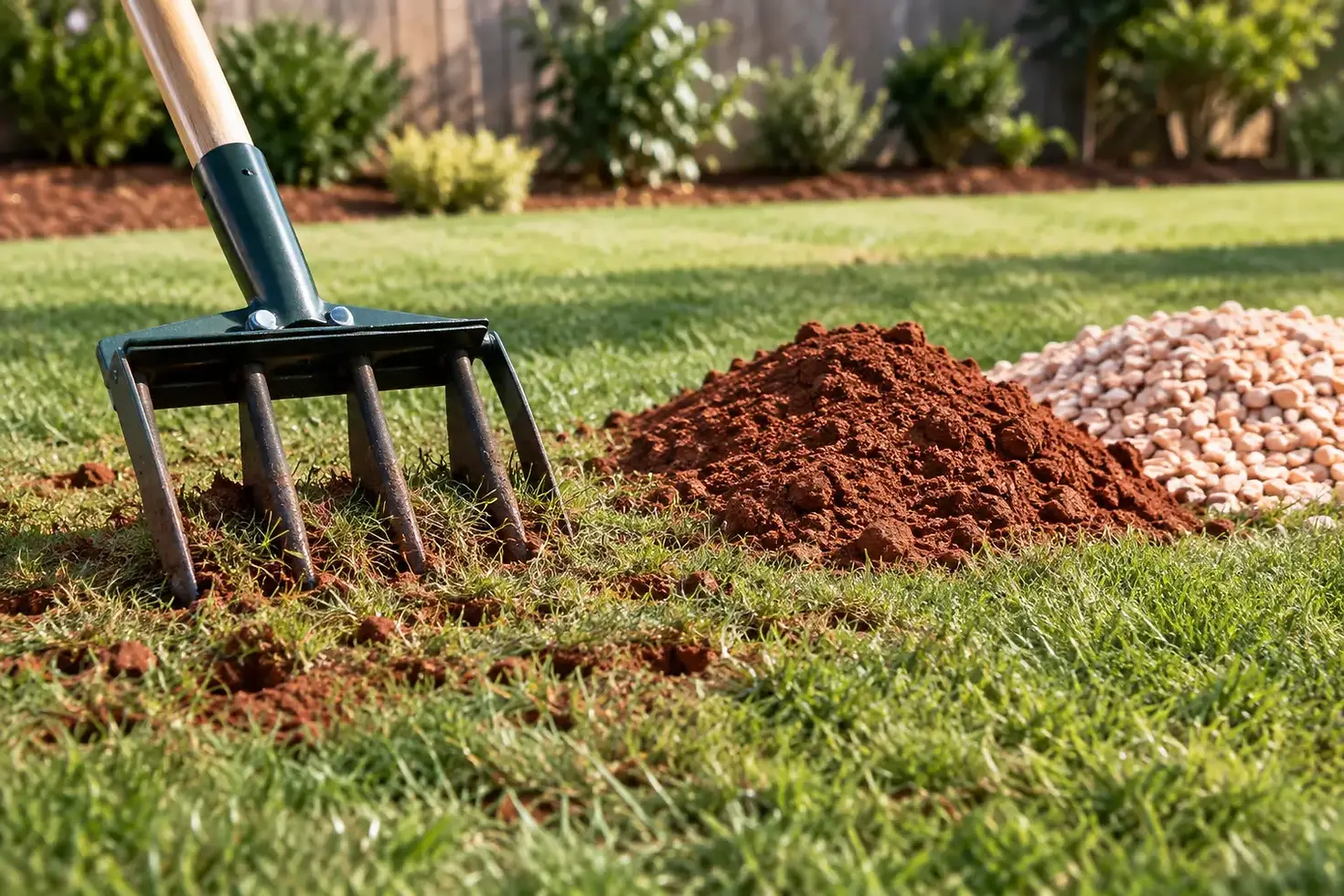
For an established lawn, core aeration is usually the first practical move. A core aerator pulls small plugs from the turf and leaves holes behind. Those openings reduce density, improve gas exchange, and give water and organic material a path into the root zone.
Use a true plug or core aerator, not just a spike roller. Spikes press soil outward and can make already dense ground tighter around the hole. Core aeration removes material, which creates room for the surrounding soil to relax.
Timing depends on turf type, irrigation, and weather. For cool-season lawns common in Utah, early fall is often the best window because turf can recover in moderate temperatures. Spring aeration can also work when the lawn is actively growing and the ground is not saturated. Avoid working frozen soil or running equipment over wet ground. That causes ruts and creates another compaction problem.
On a heavily used commercial lawn, one pass may not be enough. Make two passes in different directions where soil is especially hard, but do not turn a stressed lawn into loose mud. The goal is consistent openings through the turf, not maximum disturbance in one day.
Mow, Water, Then Aerate
Mow the turf to its regular height before aerating. Water lightly one or two days ahead if the ground is dry enough that the machine cannot pull cores. The soil should be moist, not muddy. If plugs smear instead of coming out cleanly, wait for better conditions.
Leave the cores on the lawn unless there is a specific cleanup reason. They break down, return soil and organic matter to the surface, and do not damage a healthy mower. On visible entrance areas, crews may choose to drag the plugs lightly after they have dried.
Topdress With Compost, Not Just Sand
Aeration opens the door. Compost helps improve what happens after the holes close.
A thin topdressing of quality fine wood compost adds stable organic matter to the topsoil. Organic matter supports aggregation, meaning soil particles begin to form small, workable clusters rather than one hard mass. That creates better space for water, air, microbes, and roots. It also improves moisture holding, which matters when hot, dry Utah weather arrives.
For most established lawns, spread compost about 1/4 inch deep after core aeration. That is roughly three-quarters of a cubic yard per 1,000 square feet. A 1/2-inch application can be appropriate on a rough, depleted site, but it should be worked into the canopy so grass blades are not buried. Keep the layer light and even.
Fine material matters. Coarse chunks are harder to spread across turf and can interfere with mowing. A screened, low-salt compost is the better fit for lawns, beds, tree wells, and other finished landscape areas. SuperSoil USA supplies fine wood compost and Ferrozite-enhanced Super Soil in bulk for crews that need practical coverage rates and jobsite delivery.
Sand is sometimes used for leveling or managing a specific sports-turf profile, but sand alone is not a universal fix for compacted lawns. On clay-dominant soil, adding a small amount of sand without enough organic matter can create a dense, concrete-like mix. If leveling is the main goal, use a material selected for that purpose. If the goal is healthier soil structure, compost should be part of the plan.
Fix the Conditions That Re-Compact the Lawn
Aeration and compost help, but the lawn will tighten up again if the traffic and watering habits stay the same. Change the conditions that caused the problem where possible.
Keep mower turns out of the same narrow area. Rotate travel routes for utility vehicles and avoid parking equipment on turf. If a gate or service door creates a permanent traffic lane, consider adding a durable access path rather than repeatedly repairing grass that does not have a fair chance to establish.
Irrigation deserves a close look. Short, frequent watering keeps roots near the surface and can leave fine soils weak and slick. Water deeply enough to reach the active root zone, then allow the upper soil to dry somewhat before the next cycle. The exact schedule depends on soil texture, slope, weather, sprinkler output, and local watering rules. A lawn on sandy ground needs a different approach than a lawn built on dense clay fill.
Avoid heavy equipment during wet periods. This matters on construction punch lists, school grounds, and HOA properties where final cleanup can happen late in the season. One loaded truck crossing wet turf can undo a great deal of soil preparation. Identify dump spots, equipment routes, and staging areas before delivery day so bulk materials stay off the lawn whenever possible.
When Aeration Is Not Enough
Some lawns are compacted deeper than a core aerator can reach. This is common on recently built lots where topsoil was stripped, subsoil was driven over, and a thin layer of finish soil was placed on top. It is also common in parking-lot islands and areas with repeated construction access.
If water continues to pond, roots remain shallow, and probes hit a hard layer several inches down after repeated aeration, deeper renovation may be needed. On a small lawn, that can mean removing turf, loosening the soil 6 to 8 inches deep, incorporating compost, grading correctly, and reseeding or resodding. On larger commercial areas, use equipment that can decompact soil without mixing poor subsoil into the finished root zone more than necessary.
Before tilling, verify irrigation lines, wiring, drainage components, and other buried utilities. Tilling is useful during renovation, but it is not a routine maintenance tool for an established lawn. Repeated tilling can damage turf, bring up rocks, and create a fluffy surface that settles unevenly.
Build Better Soil During Dormant-Season Work
Fall and winter are useful planning seasons for properties that need broader soil correction. Crews can identify thin turf, compacted islands, drainage trouble, and traffic damage while plants are dormant and before spring schedules fill up. Where access allows, apply and incorporate compost during renovation work so the root zone is ready before planting and heat return.
For bulk compost, enhanced topsoil, and delivery planning in Utah and surrounding states, call 435-896-5970. Ask about the area being covered, the intended depth, access for delivery, and a safe dump location. Materials are best ordered by cubic yards, not guesswork.
A compacted lawn rarely improves from a single heavy watering or another fertilizer application. Give roots air, add organic matter where it belongs, and protect the soil from the next round of traffic. That is how turf gets stronger from the ground up.


Comments